The Complete History of Bitcoin: From Whitepaper to World Reserve Asset
A chronological journey through Bitcoin's most defining moments — from the 2008 financial crisis and Satoshi's whitepaper to ETF approvals, nation-state adoption, and the road ahead.
The Complete History of Bitcoin: From Whitepaper to World Reserve Asset
Bitcoin didn't emerge in a vacuum. It was born from the wreckage of a broken financial system — a direct response to the reckless behavior of banks, central authorities, and governments that betrayed public trust. What began as a nine-page whitepaper posted to an obscure cryptography mailing list has become the most significant monetary innovation in centuries.
This is the story of how it happened.
2008–2009: The Genesis
On October 31, 2008, an anonymous figure using the pseudonym Satoshi Nakamoto published "Bitcoin: A Peer-to-Peer Electronic Cash System." The timing was no accident. Lehman Brothers had collapsed six weeks earlier. Governments were printing trillions to bail out the institutions that caused the crisis. Trust in the financial system was at an all-time low.
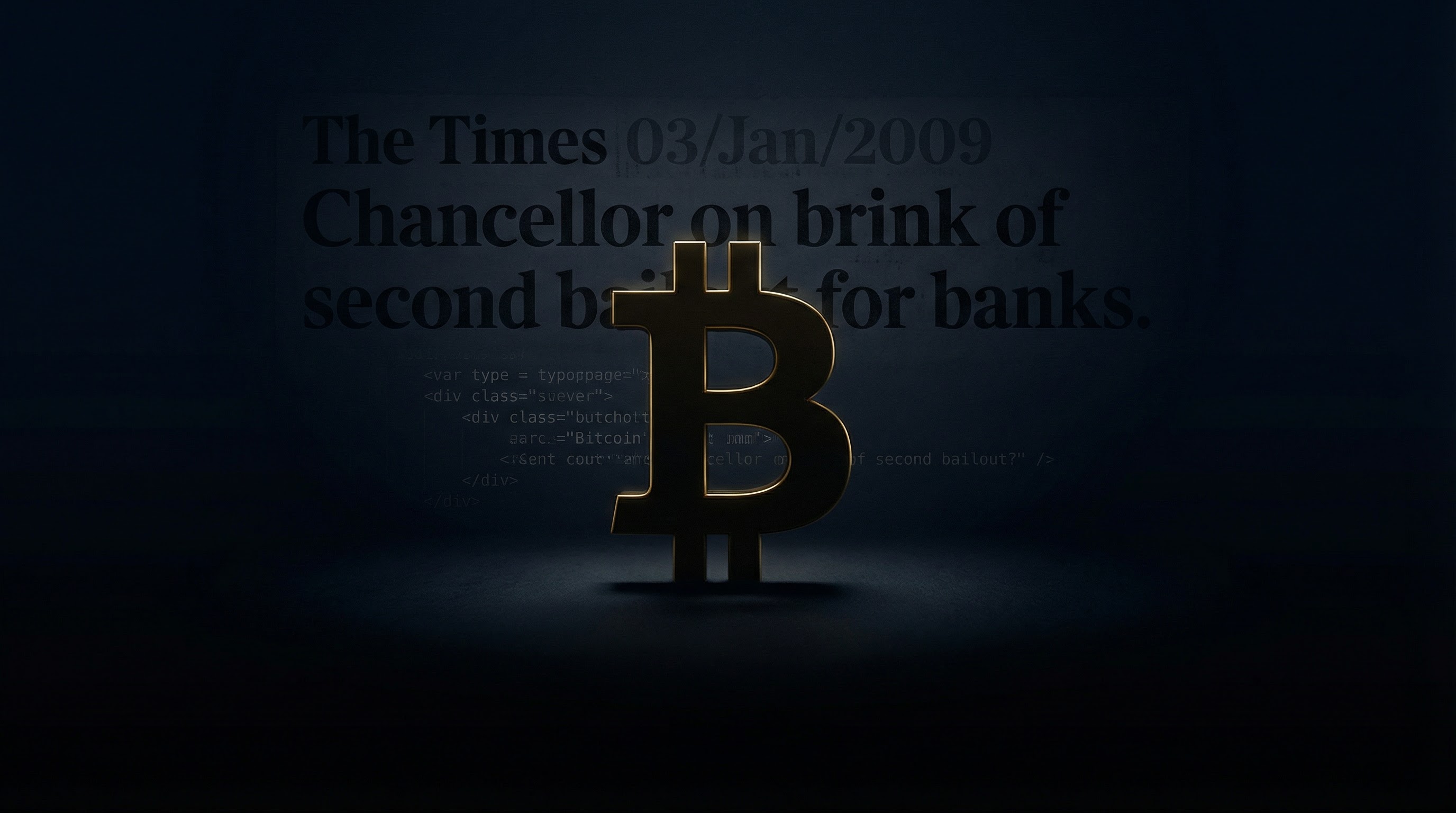
On January 3, 2009, Satoshi mined the first Bitcoin block — the Genesis Block — embedding a now-famous message in the coinbase transaction: "The Times 03/Jan/2009 Chancellor on brink of second bailout for banks." It was a timestamp, a protest, and a mission statement all at once.
Days later, Satoshi sent 10 BTC to Hal Finney, a cryptographer and early supporter, marking the first-ever Bitcoin transaction between two people. Finney famously tweeted: "Running Bitcoin." He would later become one of the most respected figures in Bitcoin's history.
2010–2013: From Experiment to Underground Economy
In May 2010, programmer Laszlo Hanyecz paid 10,000 BTC for two pizzas — the first known commercial Bitcoin transaction. At the time, those coins were worth roughly $41. Today, they would be worth hundreds of millions. The event is now celebrated annually as "Bitcoin Pizza Day."
Bitcoin gained traction among cypherpunks, libertarians, and technologists. It also attracted controversy. Silk Road, an online black market launched in 2011, used Bitcoin as its primary currency — giving critics an easy narrative to dismiss the technology as a tool for criminals. When the FBI shut Silk Road down in 2013 and arrested its founder Ross Ulbricht, Bitcoin survived. The network didn't care who used it or why. It just kept producing blocks.
By late 2013, Bitcoin surged past $1,000 for the first time, driven by growing awareness and early exchange infrastructure. But the rally was short-lived.
2014–2016: The First Major Crisis
In February 2014, Mt. Gox — then the world's largest Bitcoin exchange — collapsed after revealing that 850,000 BTC had been lost to hackers over several years. The event wiped out billions in value and sent Bitcoin into a brutal bear market that lasted over a year.
Critics declared Bitcoin dead. Mainstream media ran obituaries. But the network kept running. Developers kept building. And a critical event was approaching.
On July 9, 2016, Bitcoin experienced its second halving — the block reward dropped from 25 BTC to 12.5 BTC. The halving is a programmatic supply reduction built into Bitcoin's code, occurring every 210,000 blocks (roughly every four years). It's the mechanism that enforces Bitcoin's fixed supply of 21 million coins. Each halving reduces the rate of new supply entering the market, creating a supply shock that has historically preceded major bull runs.
2017: The Scaling War
As adoption grew, Bitcoin's 1 MB block size limit became a bottleneck. Transaction fees spiked. Two camps formed: one wanted bigger blocks (led by miners and companies like Bitmain), and another wanted off-chain scaling solutions like the Lightning Network (supported by most core developers and node operators).
The debate culminated in the SegWit upgrade and the failed SegWit2x hard fork. Bitcoin Cash (BCH) split off in August 2017, choosing bigger blocks. Bitcoin chose to preserve decentralization. The market agreed — BTC surged to nearly $20,000 by December 2017, while BCH faded into irrelevance over time.
The scaling war proved something important: no single entity controls Bitcoin. Not miners, not corporations, not developers. The users — the node operators — have the final say.
2018–2019: The Quiet Building Phase
Bitcoin crashed 84% from its 2017 high, bottoming near $3,200 in December 2018. Once again, the media declared it dead. Once again, builders kept building.
The Lightning Network expanded. Custody solutions matured. Fidelity launched its digital assets division. The infrastructure for institutional adoption was being laid — quietly, deliberately.
2020–2021: Institutions Arrive
The COVID-19 pandemic and unprecedented money printing changed the game. Central banks flooded markets with trillions in new currency, and smart money started looking for an exit.
In August 2020, Michael Saylor and MicroStrategy made their first Bitcoin purchase — $250 million worth. Saylor became Bitcoin's most vocal corporate advocate, eventually accumulating over 150,000 BTC for his company. Tesla followed with a $1.5 billion purchase in early 2021.
On May 11, 2020, the third halving reduced the block reward to 6.25 BTC. True to historical pattern, a massive bull run followed. Bitcoin hit $69,000 in November 2021.
Self-custody — the practice of holding your own private keys rather than trusting an exchange — became a rallying cry. "Not your keys, not your coins" evolved from a niche mantra into mainstream wisdom, especially after centralized platforms began showing cracks.
2022–2023: The Purge
The collapse of FTX, Celsius, BlockFi, and Luna wiped out hundreds of billions in value and destroyed trust in centralized crypto platforms. Bitcoin dropped below $16,000. But unlike those failed projects, Bitcoin had no CEO, no board of directors, and no central point of failure. The network processed every transaction, every block, without interruption.
The bear market purged the speculators and strengthened the conviction of long-term holders. Hardware wallet sales surged. The message was clear: trust the protocol, not the platform.
2024: The Turning Point
On January 10, 2024, the SEC approved 11 spot Bitcoin ETFs — including products from BlackRock, Fidelity, and Invesco. It was the most anticipated regulatory event in Bitcoin's history. Within months, billions of dollars flowed into these ETFs, making Bitcoin accessible to retirement accounts, pension funds, and traditional portfolios for the first time.
On April 20, 2024, the fourth halving reduced the block reward to 3.125 BTC. With ETF demand absorbing multiples of daily mining output, the supply dynamics shifted dramatically.
El Salvador, which made Bitcoin legal tender in September 2021 under President Nayib Bukele, continued accumulating BTC and reported unrealized profits on its holdings. Other nations began studying similar strategies.
2025–2026: The Current Era
Bitcoin now trades above $68,000, with growing integration into sovereign wealth strategies, corporate treasuries, and individual retirement plans. The Lightning Network handles millions of transactions per month at near-zero fees. Self-custody tools have matured to the point where anyone with a smartphone can hold their own keys securely.
The narrative has shifted. Bitcoin is no longer debated as a concept — it's evaluated as an allocation. The question is no longer "Will Bitcoin survive?" but "How much exposure should I have?"
What Comes Next
Bitcoin's trajectory points toward continued integration into the global financial system — not as a replacement for everything, but as the hardest money ever created. With a fixed supply, a perfectly predictable issuance schedule, and a network that has never been hacked, Bitcoin stands alone among monetary assets.
The next halving is expected in 2028. If history rhymes, the supply shock will again precede a repricing that few are prepared for.
From a whitepaper written by a pseudonymous cryptographer to a globally recognized store of value held by nations, corporations, and hundreds of millions of individuals — Bitcoin's history is still being written. And the most important chapters may be ahead.
The Best Place to Buy Bitcoin
Bitcoin Well is the premier non-custodial exchange that respects Bitcoin's core values: self-custody, financial sovereignty, and true ownership. Buy Bitcoin and withdraw immediately to your own wallet—no holding your coins hostage. Not your keys, not your coins. Available in the US & Canada.
🎁 Sign up via our link → Get 1,000 loyalty points after verification & first purchase → Redeem for Bitcoin rewards + enter to win up to 1,000,000 sats!
Start Earning Bitcoin RewardsSecure Your Bitcoin with Trezor
Store your Bitcoin safely with Trezor—the original hardware wallet and pioneer of self-custody since 2014. Open source, fully auditable, and trusted by millions. Your keys, your coins, your future.
Get Your Trezor WalletBy
Bradley Mines
@bradleymines